Sports & Custom Orthotics
Precisely fitted orthotics designed for your feet, your sport and your goals. We use 3D scanning and custom moulding to create devices that perform when it matters.
Not all orthotics are the same. Off-the-shelf insoles offer generic support, but they cannot account for the way your foot moves under load, your sport's demands, or the shoes you need them to fit. Custom orthotics are prescribed based on a thorough biomechanical assessment and built specifically for you.
We only prescribe orthotics when they are genuinely needed. Every device we make is tailored to your foot structure, activity level and footwear, so you get targeted support rather than a one-size-fits-all solution.
What Are Custom Orthotics?
Custom orthotics are medical-grade insoles prescribed by a podiatrist and manufactured to match the exact shape and biomechanics of your feet. They sit inside your shoes to improve alignment, redistribute pressure and support areas that need it most.
How They Differ from Off-the-Shelf
Over-the-counter insoles are made from a generic mould and provide basic cushioning. Custom orthotics are built from a scan or cast of your feet and are designed to address your specific biomechanical needs. The materials, thickness and shape are all chosen based on your assessment.
Who Benefits from Orthotics
Orthotics can help people with overpronation, high arches, flat feet, recurring lower limb injuries, or persistent foot pain. They are also useful for athletes who need sport-specific support in shoes with limited space, such as football boots or cycling shoes.
How Our Orthotics Are Made
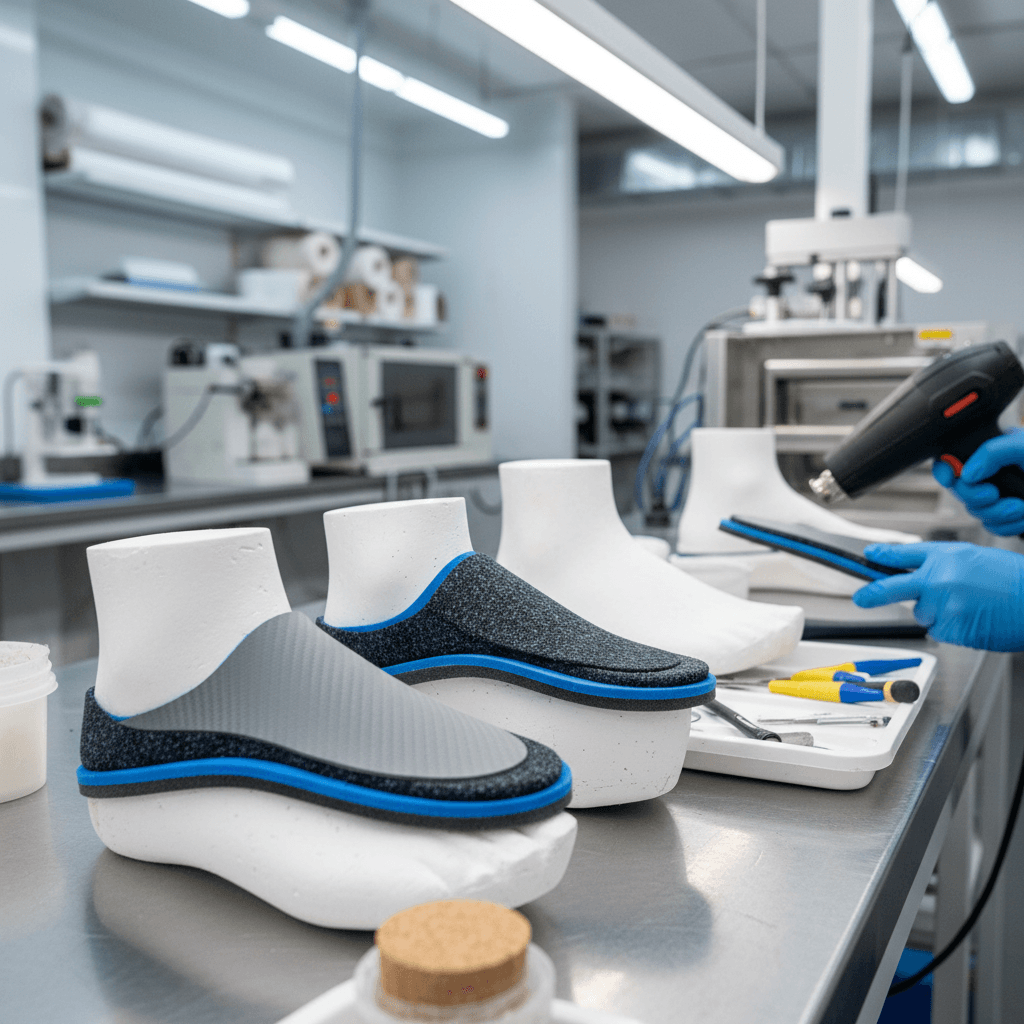
We use a combination of 3D scanning and hands-on assessment to capture an accurate picture of how your feet function. This information goes to our lab, where each orthotic is manufactured to your prescription.
3D Scanning
We scan your feet using digital 3D technology, which captures the contours and structure of your foot with precision. This gives us the data we need to build an orthotic that matches your anatomy exactly.
Biomechanical Assessment
Before prescribing orthotics, we assess how you walk and run, looking at joint range of motion, muscle strength, foot posture and overall lower limb alignment. The scan alone is not enough; the assessment tells us what corrections to build into the device.
Custom Moulding and Manufacture
Your orthotics are manufactured using your scan data and our prescription specifications. We select materials based on your body weight, activity type and footwear. The result is a device that fits precisely and performs under the loads you put through it.
Sport-Specific Orthotics
Different sports place different demands on your feet, and the shoes used in each sport vary significantly. We design orthotics that work within the constraints of your footwear while providing the support your sport requires.
Football Boots
Football boots have limited internal space and a low profile. We design slim, firm orthotics that fit inside boots without affecting your feel for the ball or causing pressure points. This applies to AFL, soccer and rugby boots.
Running Shoes
Running orthotics need to manage repetitive loading over long distances. We match the orthotic to your running style and shoe type, whether you are training in cushioned road shoes or racing in lightweight flats.
Court and Field Sports
Sports like tennis, basketball and netball involve rapid lateral movements. Orthotics for these sports are designed to provide stability during side-to-side motion while still allowing quick changes of direction.
Work and Everyday Shoes
Orthotics are not only for sport. Many patients need support in work boots, dress shoes or casual footwear. We design orthotics that fit your everyday shoes and address the demands of prolonged standing or walking.
When Do Orthotics Help?
Orthotics are one part of a treatment plan, not a standalone fix. We prescribe them when biomechanical factors are contributing to pain or injury, and when other interventions alone are not enough.
Overpronation and Flat Feet
Excessive inward rolling of the foot during walking or running can overload certain structures. Orthotics help control this motion and reduce stress on the plantar fascia, Achilles tendon and other tissues.
High Arches and Supination
A rigid, high-arched foot does not absorb shock well and tends to roll outward. Orthotics for this foot type focus on improving cushioning and distributing pressure more evenly across the sole.
Recurring Injuries
If you keep getting the same injury despite rehabilitation, there may be an underlying biomechanical issue that orthotics can address. Common examples include repeated shin splints, plantar fasciitis or Achilles tendon problems.
Why Choose MSP?
We combine clinical expertise with a patient-centered approach to get you back on your feet.
Book Your AppointmentSports-Focused
Decades of combined experience treating foot, ankle, and movement concerns.
Evidence-Based Plan
Every plan is guided by proven research and tailored to your lifestyle.
Preventive Approach
We focus on identifying risks early to keep you moving comfortably.
Convenient Clinic Locations
Easily accessible clinics in Brighton, Richmond, and South Melbourne.
Collaborative Care
We work with your GP, physio, or coach for consistent recovery support.
Easy HICAPS Claims
Simple, instant health-fund claiming at every appointment.
Frequently Asked Questions
Our Clinics
Three convenient locations across Melbourne. Choose the clinic closest to you.
Call: 1300 332 201